Horror, Thriller Pyschological
The Tower of London: Where History Learns to Watch You
Diya R Vinodkumar
•3 min read
Tower of London embodies authority, silence, inevitability, and institutional memory.
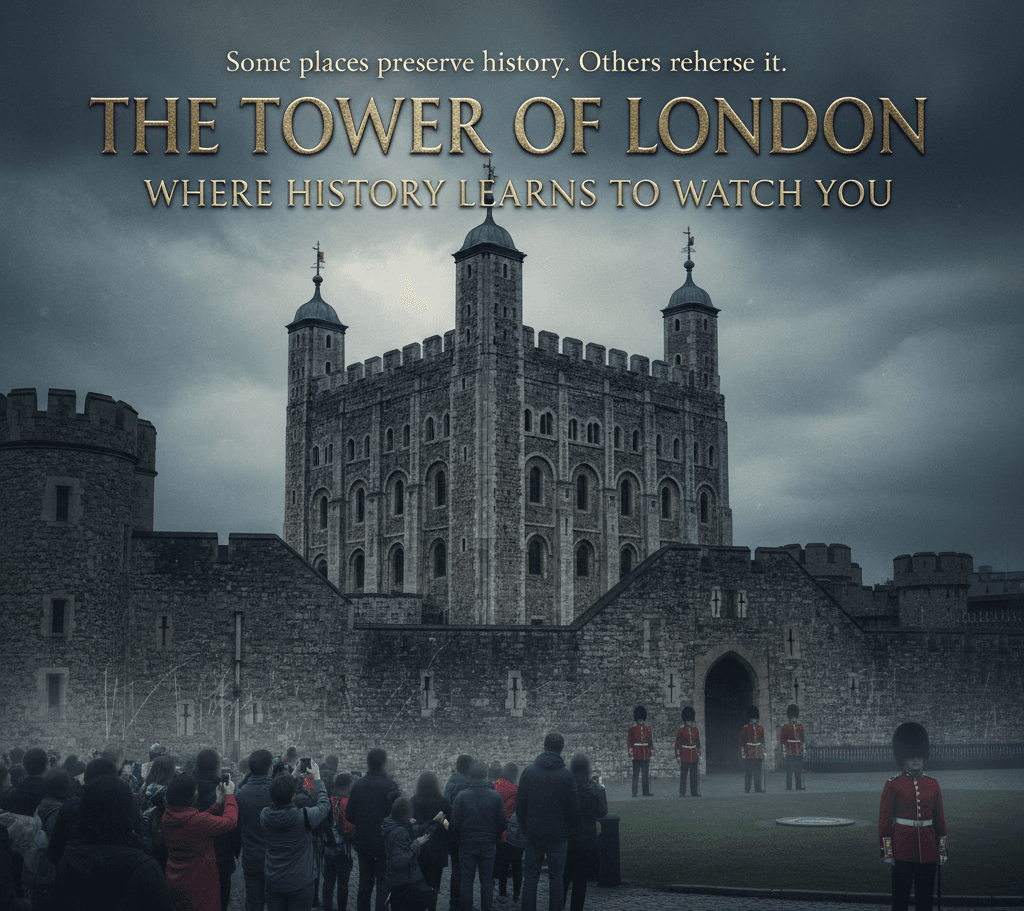
Some places preserve history.
Others rehearse it.
The Tower of London has been many things—fortress, palace, prison, execution ground—but it has never been empty. Even now, surrounded by traffic and cameras and crowds, it carries itself like a place that expects silence to return eventually.
As if the present is only temporary.
From the outside, the Tower feels controlled. Stone walls. Ordered paths. Uniformed guards. Everything suggests containment.
Step inside, and that illusion weakens.
The air feels dense, as though it has absorbed too many final thoughts. Not dramatic ones—quiet, practical thoughts. Regret. Confusion. The slow understanding that no appeal is coming.
This was not a place of chaos.
It was a place of procedure.
Thousands passed through the Tower not because they were monsters, but because they were inconvenient. Political threats. Religious obstacles. Heirs who complicated succession.
The Tower did not need cruelty to be terrifying.
It only needed authority.
That is what still lingers.
Walk along Tower Green, and you’ll find a small memorial marking where private executions took place. No raised platform. No spectacle.
Just a patch of ground.
People speak softly here without being told to. Cameras lower. Jokes stop mid-sentence.
The body understands before the mind does: this was a place where voices were reduced to compliance.
Psychologically, the Tower works in layers.
At first, it overwhelms you with facts. Dates. Names. Charges. Outcomes. The brain latches onto information as armor.
But as you move deeper—past the White Tower, into cells and corridors—the human details begin to leak through.
Scratches on walls. Carved prayers. Initials cut into stone by hands that knew time had narrowed.
These are not ghost stories.
They are negotiations with inevitability.
Many claim the Tower is haunted.
They speak of Anne Boleyn, walking headless across the grounds. Of footsteps echoing in empty corridors. Of cold spots, whispers, the sensation of being followed.
Skeptics dismiss these as suggestion.
But suggestion doesn’t explain why the unease remains even when nothing happens.
Because the Tower’s horror is not supernatural.
It is institutional.
This is a place where power learned how to feel normal.
Where executions were justified by paperwork. Where suffering was managed, scheduled, made efficient.
The stone absorbed that normalization.
And stone does not forget easily.
Stand in one of the old cells long enough, and something unsettling emerges: not fear, but empathy so sharp it becomes uncomfortable.
You imagine waiting.
Not for rescue. Not for mercy.
Just for information.
The human mind is not built for that kind of uncertainty.
And the Tower specialized in it.
What makes the Tower of London disturbing isn’t the bloodshed or the legends.
It’s the realization that everything that happened here was considered necessary at the time.
Reasonable. Lawful. Inevitable.
That logic echoes forward, quietly, into the present.
When you leave the Tower, you re-enter a city that feels loud, fast, and strangely fragile. The river moves. Traffic flows. Life resumes.
But the Tower remains behind you, unchanged.
Watching.
Not because it is alive—
—but because it was built to observe
who holds power
and how long they manage to keep it.
And history, as the Tower reminds us, is very patient.