Horror, Thriller Pyschological
Bhangarh: The Place That Knows When You’re Afraid
Diya R Vinodkumar
•3 min read
Bhangarh Fort unsettles visitors, blending psychology, legend, and haunting awareness.
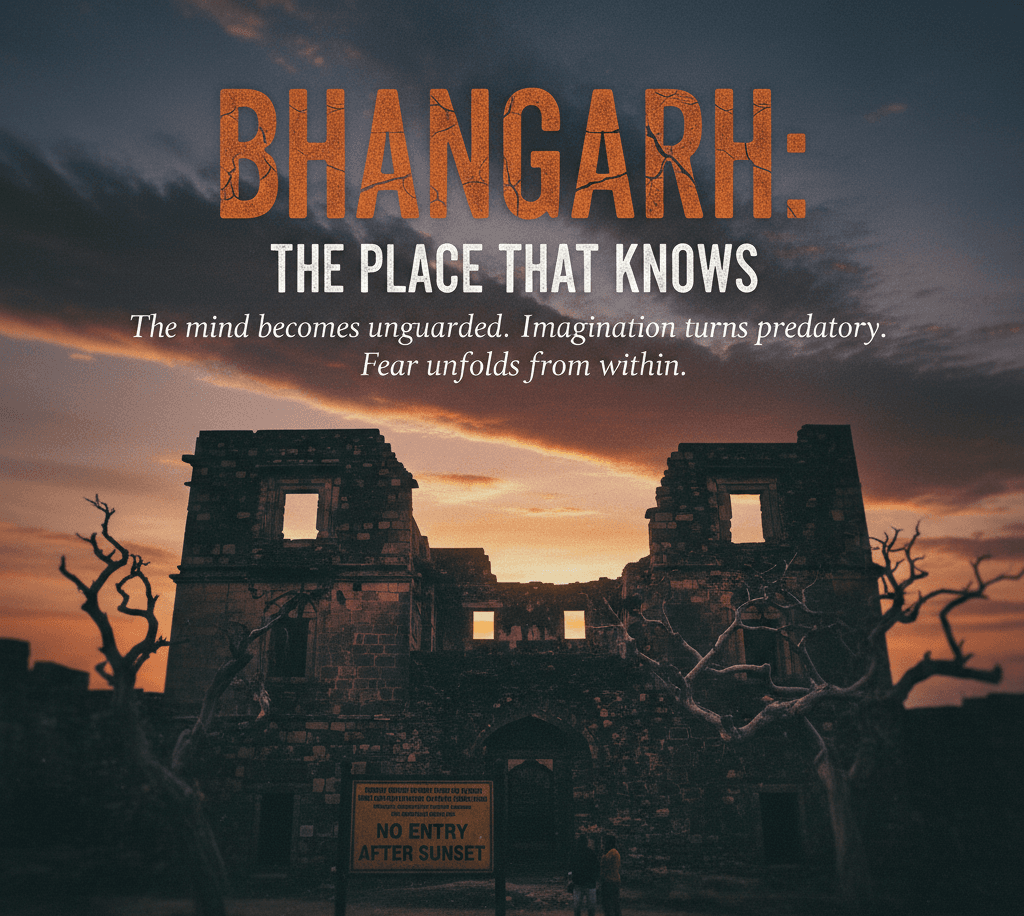
There are places that feel abandoned, and then there are places that feel aware.
Bhangarh Fort is the second kind.
From a distance, it looks ordinary—ruins folded into the Aravalli hills, stone walls softened by time. Tourists arrive with cameras. Guides rehearse familiar stories. The sun still shines. Birds still cross the sky.
And yet, something in you tightens the moment you pass the gate.
Not fear.
Recognition.
Bhangarh is often called the most haunted place in India, but that word feels lazy here. “Haunted” suggests interruption—ghosts invading a place meant for the living.
Bhangarh feels inverted.
As if the living are the ones intruding.
The stories come first, as they always do.
A cursed fort.
A rejected sorcerer.
A princess whose beauty became a sentence of death.
A kingdom doomed by a single wrong desire.
You hear these tales before you ever step inside, and maybe that’s the point. Maybe the fear needs a doorway.
But what unsettles people who visit Bhangarh isn’t what happened there.
It’s what persists.
There’s a sign near the entrance issued by the Archaeological Survey of India: no entry after sunset. Officially, it’s about safety. Wildlife. Crumbling structures.
Unofficially, everyone knows what it implies.
The fort does not want witnesses at night.
People who ignore the warning report the same sensations, even when they don’t know the legends. A sudden heaviness in the chest. Disorientation. The feeling of being observed—not watched, but measured.
As if the place is deciding something about you.
Walk deeper inside, and the ruins begin to feel intentional. Not random decay, but restraint. Houses with doorways that lead nowhere. Temples that seem to swallow sound. Corridors where your footsteps arrive a fraction of a second too late.
Psychologists would call it expectation bias. The power of suggestion.
But suggestion doesn’t explain why people lower their voices instinctively.
Or why laughter feels inappropriate, even disrespectful.
Or why the urge to leave often comes without a clear reason.
You don’t think, I’m scared.
You think, I shouldn’t be here.
What makes Bhangarh disturbing is not the idea of ghosts, but the erosion of certainty.
Time feels unreliable inside the fort. Minutes stretch. Orientation slips. People report walking in circles without realizing it, returning to the same spot convinced they were moving forward.
The mind begins to compensate. It fills gaps. It invents logic.
And that’s where the real horror lives.
Because the brain, when denied clarity, will create meaning—even if that meaning is fear.
There is a theory rarely mentioned in guidebooks: that Bhangarh doesn’t contain something supernatural—it induces something psychological.
Isolation. Ruins. Silence broken only by wind and birds. A strong narrative of doom. The human mind, exposed to all of it at once, turns inward.
You begin to notice your own thoughts too clearly.
Your breathing.
Your heartbeat.
The quiet question of what if the stories are true?
And once that question forms, Bhangarh doesn’t answer it.
It lets you answer it yourself.
Some visitors leave disappointed. They say nothing happened. No voices. No apparitions. No shadows moving on their own.
But many of them still quicken their pace on the way out.
Still glance back once.
Still feel relief when the fort disappears behind them.
Because even without proof, the feeling remains: that Bhangarh noticed them—and allowed them to leave.
Maybe the curse isn’t supernatural at all.
Maybe Bhangarh is simply a place where the mind becomes unguarded, where imagination turns predatory, where fear doesn’t jump out at you but slowly unfolds from within.
A place that doesn’t chase you.
A place that waits.
And if you ever find yourself standing at its gate as the sun begins to sink, feeling the inexplicable urge to stay just a little longer—
Pay attention.
That isn’t curiosity.
That’s the fort recognizing you.